
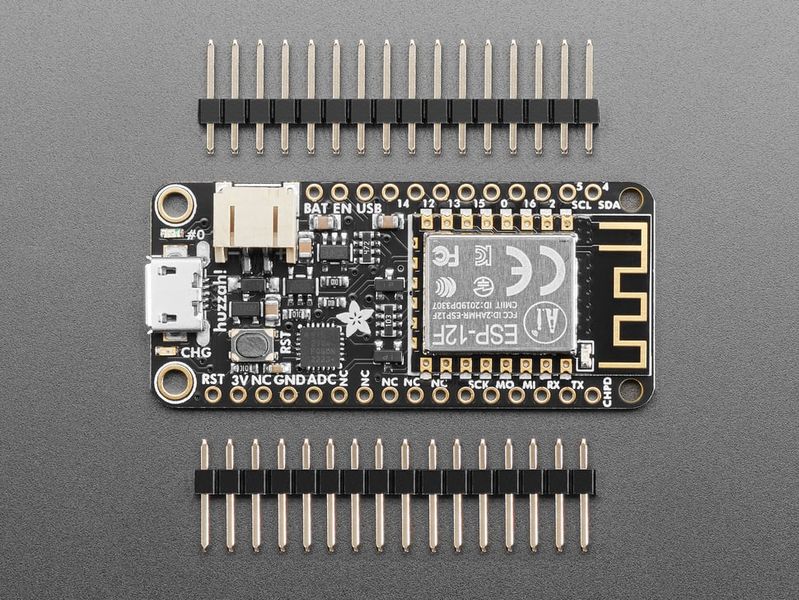
Feather HUZZAH ESP8266 by Adafruit
Feather is the development board from Adafruit, and like its namesake, it is thin, light, and lets you fly! We designed Feather to be a new standard for portable microcontroller cores.
This is the Adafruit Feather HUZZAH ESP8266 - our take on an ‘all-in-one’ ESP8266 WiFi development board with built-in USB and battery charging. It’s an ESP8266 WiFi module with all the extras you need, ready to rock!
At the Feather HUZZAH’s heart is an ESP8266 WiFi microcontroller clocked at 80 MHz and at 3.3V logic. This microcontroller contains a Tensilica chip core as well as a full WiFi stack. You can program the microcontroller using the Arduino IDE for an easy-to-run Internet of Things core. We wired up a high-quality SiLabs CP2104 USB-Serial chip that can upload code at a blistering 921600 baud for fast development time. It also has auto-reset so no noodling with pins and reset button pressings.
To make it easy to use for portable projects, we added a connector for any of our 3.7V Lithium polymer batteries and built-in battery charging. You don’t need a battery, it will run just fine straight from the micro USB connector. But, if you do have a battery, you can take it on the go, then plug in the USB to recharge. The Feather will automatically switch over to USB power when it’s available.
Main features:
- Measures 2.0” x 0.9” x 0.28” (51mm x 23mm x 8mm) without headers soldered in
- Light as a (large?) feather - 6.1 grams
- ESP8266 @ 80MHz with 3.3V logic/power
- 4MB of FLASH (32 MBit)
- Built in WiFi 802.11 b/g/n
- 3.3V regulator with 500mA peak current output
- CP2104 USB-Serial converter onboard with 921600 max baudrate for speedy uploading
- Auto-reset support for getting into bootload mode before firmware upload
- 9 x GPIO pins - can also be used as I2C and SPI
- 1 x analog inputs 1.0V max
- Built-in 100mA LiPoly charger with charging status indicator LED
- Pin #0 red LED for general purpose blinking. Pin #2 blue LED for bootloading debug & activity status
- Reset button
Purchase
Contribute
Have some info to add for this board? Edit the source for this page here.
Adafruit Blinka Installation
We use a special library called adafruit_blinka (named after Blinka, the CircuitPython mascot) to provide the layer that translates the CircuitPython hardware API to whatever library the Linux board provides.
For example, on Raspberry Pi we use the python RPi.GPIO library. For any I2C interfacing we'll use ioctl messages to the /dev/i2c device. For SPI we'll use the spidev python library, etc. These details don't matter so much because they all happen underneath the adafruit_blinka layer.
Features: Feather-Compatible, Wi-Fi
Board Usage Options: MicroPython Board