
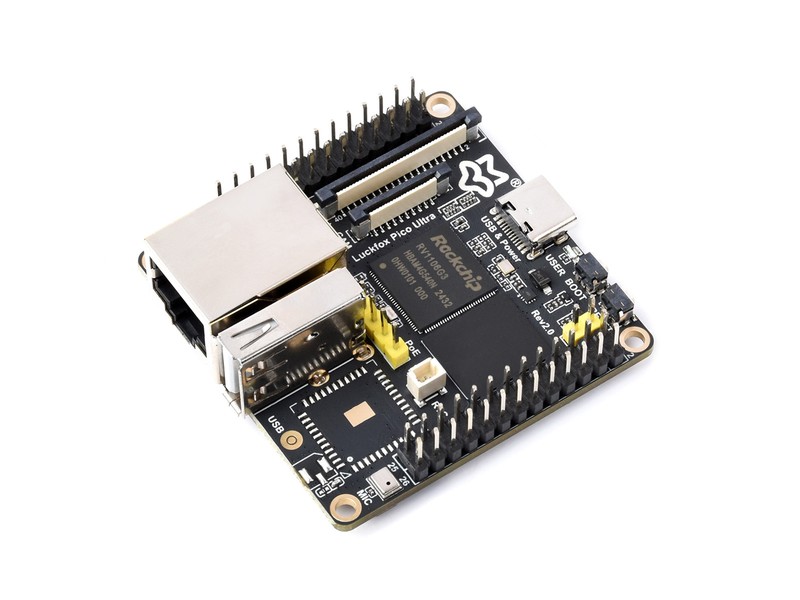
LuckyFox Pico Ultra by LuckyFox
LuckFox Pico Ultra is a low-cost Linux micro development board based on the Rockchip RV1106G3 chip. RV1106 is a highly integrated IPC visual processing SoC designed for AI-related applications. It is built on a single-core ARM Cortex-A7 32-bit core with integrated NEON and FPU, and features a built-in NPU that supports INT4/INT8/INT16 mixed operations, with a computing power of up to 1 TOPS.
It features a hardware-based ISP that supports various algorithm accelerators such as HDR, 3A, LSC, 3DNR, 2DNR, sharpening, haze removal, gamma correction, and more. Additionally, it has a built-in 16-bit DDR3L DRAM to maintain demanding memory bandwidth, as well as built-in POR, audio codec, and MAC PHY.
The board supports multiple interfaces including GPIO, UART, SPI, I2C, USB, and more, facilitating rapid development and debugging. The Ultra variant includes 256MB DDR3L memory, 8GB eMMC onboard storage, a 10/100M Ethernet port, PoE support, and a reserved header for optional WiFi 6 + Bluetooth 5.2 module (available on the Ultra W variant).
Specifications
- Processor: Rockchip RV1106G3
- CPU: Cortex-A7 @ 1.2GHz
- NPU: 1 TOPS, supports INT4/INT8/INT16
- ISP: Max input 5M @ 30fps
- Memory: 256MB DDR3L
- Storage: 8GB eMMC
- USB: USB 2.0 Host/Device
- Camera: MIPI CSI 2-lane
- Display: RGB666 DPI interface
- PoE: IEEE 802.3af
- GPIO: 33 GPIO pins
- Ethernet: 10/100M Ethernet controller and embedded PHY
Purchase
Contribute
Have some info to add for this board? Edit the source for this page here.
Adafruit Blinka Installation
We use a special library called adafruit_blinka (named after Blinka, the CircuitPython mascot) to provide the layer that translates the CircuitPython hardware API to whatever library the Linux board provides.
For example, on Raspberry Pi we use the python RPi.GPIO library. For any I2C interfacing we'll use ioctl messages to the /dev/i2c device. For SPI we'll use the spidev python library, etc. These details don't matter so much because they all happen underneath the adafruit_blinka layer.
Features: Ethernet, Wi-Fi, Bluetooth/BLE
Board Usage Options: Linux Single Board Computer