
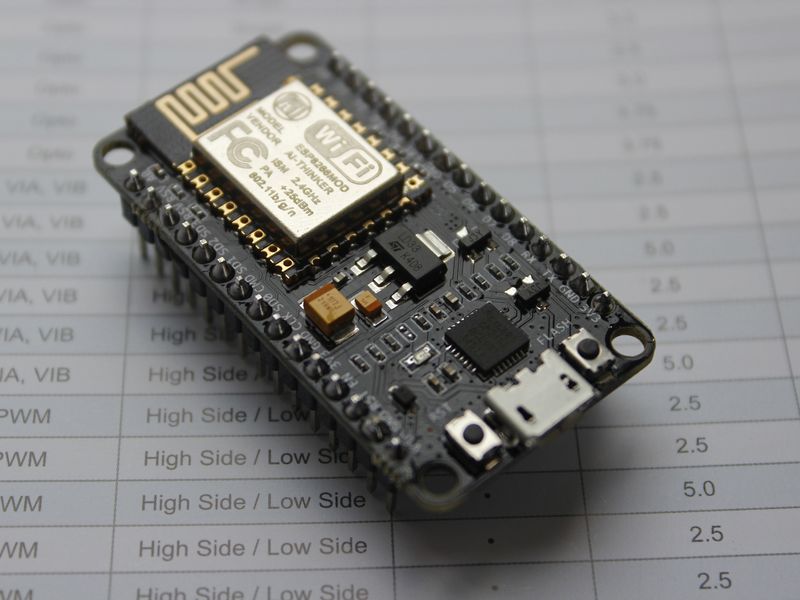
NodeMCU ESP8266 by NodeMCU
The NodeMCU is an open-source ESP8266 development board that makes working with the popular WiFi-capable microcontroller easy and accessible. It features an onboard USB-to-serial converter for simple programming and power, and breaks out all the useful GPIO pins to breadboard-friendly headers.
At its core is the ESP-12E module containing the ESP8266 SoC — a 32-bit Tensilica L106 running at 80 MHz with full WiFi 802.11 b/g/n support. With 4MB of flash, it has plenty of room for MicroPython firmware and user scripts.
Main features:
- ESP8266 @ 80MHz with 3.3V logic/power
- 4MB of FLASH (32 MBit)
- Built in WiFi 802.11 b/g/n
- Onboard USB-to-serial converter (CH340G or CP2102 depending on variant)
- Micro USB connector for power and programming
- 11 x GPIO pins with I2C, SPI, and UART support
- 1 x ADC input (0–1V)
- Two buttons: Flash and Reset
- 3.3V onboard regulator
- Breadboard-friendly form factor
The NodeMCU is one of the most popular boards for IoT projects and can run MicroPython with Adafruit Blinka for CircuitPython library compatibility.
Contribute
Have some info to add for this board? Edit the source for this page here.
Adafruit Blinka Installation
We use a special library called adafruit_blinka (named after Blinka, the CircuitPython mascot) to provide the layer that translates the CircuitPython hardware API to whatever library the Linux board provides.
For example, on Raspberry Pi we use the python RPi.GPIO library. For any I2C interfacing we'll use ioctl messages to the /dev/i2c device. For SPI we'll use the spidev python library, etc. These details don't matter so much because they all happen underneath the adafruit_blinka layer.
Features: Wi-Fi
Board Usage Options: MicroPython Board