
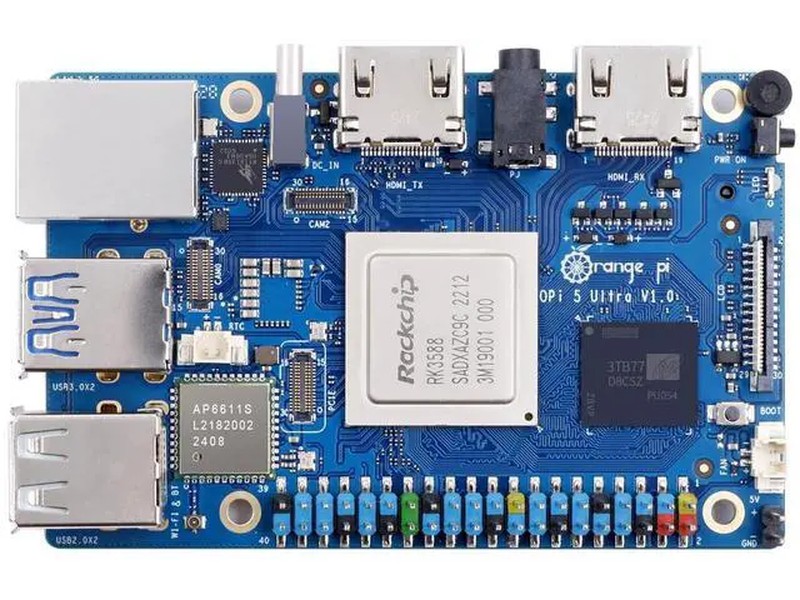
Orange Pi 5 Ultra by Shenzhen Xunlong Software CO., Limited
Orange Pi 5 Ultra is powered by the Rockchip RK3588 8-core 64-bit processor with 4 Cortex-A76 (2.4GHz) and 4 Cortex-A55 (1.8GHz) cores with independent NEON coprocessor. Adopting 8nm process design, it integrates an ARM Mali-G610 GPU compatible with OpenGL ES 1.1/2.0/3.2, OpenCL 2.2, and Vulkan 1.2. The embedded NPU supports INT4/INT8/INT16/FP16 hybrid computing with up to 6 TOPS of computing power.
It has 4GB/8GB/16GB LPDDR5, up to 8K display processing capability, supports eMMC storage, and has Wi-Fi 6E + BT 5.3 with BLE support. The board provides abundant interfaces including HDMI 2.1 output (8K@60), HDMI 2.0 input (4K@60), GPIO, USB 2.0, USB 3.0, a 3.5mm headphone jack, a PCIe-extended 2.5G Ethernet port, and an M.2 M-Key slot (PCIe 3.0 4-Lane) supporting NVMe or SATA SSDs.
Orange Pi 5 Ultra is compact at just 89mm × 57mm, and supports Orange Pi OS, Ubuntu, Android 13, Debian and other operating systems.
Specifications
- SoC: Rockchip RK3588 (8nm LP process)
- CPU: 8-core 64-bit (4× Cortex-A76 @ 2.4GHz, 4× Cortex-A55 @ 1.8GHz)
- GPU: ARM Mali-G610 (OpenGL ES 3.2, OpenCL 2.2, Vulkan 1.2)
- NPU: 6 TOPS (INT4/INT8/INT16/FP16)
- RAM: 4GB/8GB/16GB LPDDR5
- Storage: eMMC (32/64/128/256GB), 16MB QSPI NOR Flash, MicroSD, M.2 NVMe
- Video Out: HDMI 2.1 (8K@60), MIPI DSI
- Video In: HDMI 2.0 (4K@60), 2× MIPI CSI 4-lane, 1× MIPI D-PHY RX 4-lane
- Network: PCIe 2.5G Ethernet (RTL8125BG)
- WiFi + BT: Wi-Fi 6E + BT 5.3/BLE (AP6611)
- USB: 2× USB 3.0, 2× USB 2.0
- GPIO: 40-pin header
- Power: Type-C 5V/5A
Purchase
Contribute
Have some info to add for this board? Edit the source for this page here.
Adafruit Blinka Installation
We use a special library called adafruit_blinka (named after Blinka, the CircuitPython mascot) to provide the layer that translates the CircuitPython hardware API to whatever library the Linux board provides.
For example, on Raspberry Pi we use the python RPi.GPIO library. For any I2C interfacing we'll use ioctl messages to the /dev/i2c device. For SPI we'll use the spidev python library, etc. These details don't matter so much because they all happen underneath the adafruit_blinka layer.
Features: Ethernet, USB 3.0, HDMI/DisplayPort, NVME/M.2 Connector, Wi-Fi, Bluetooth/BLE, 40-pin GPIO
Board Usage Options: Linux Single Board Computer