
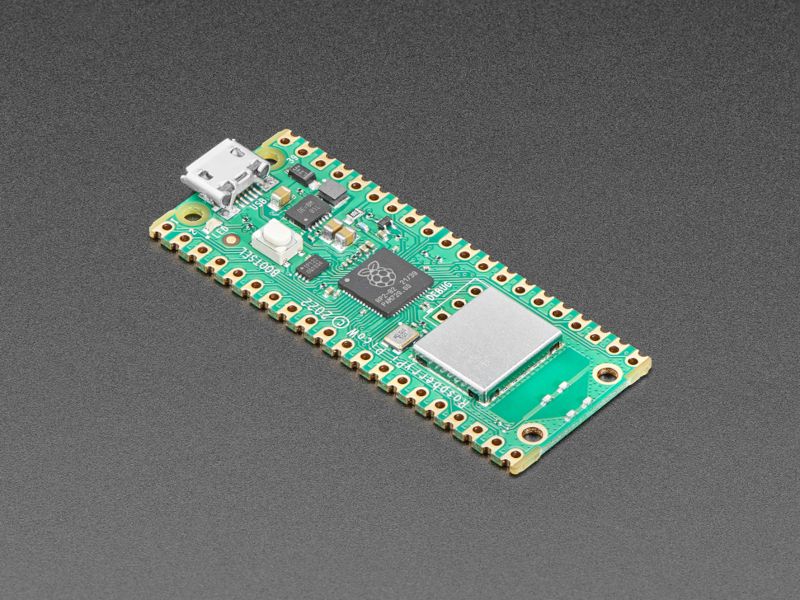
Pico W by Raspberry Pi
Raspberry Pi Pico W brings WiFi + BLE wireless networking to the Pico platform while retaining complete pin compatibility with its older sibling. It is powered by the RP2040 microcontroller and adds on-board single-band 2.4GHz wireless interfaces (802.11n) using the Infineon CYW43439 while retaining the Pico form factor.
The on-board 2.4GHz wireless interface has the following features:
- Wireless (802.11n), Single-band (2.4 GHz) WiFi with WPA3 and Soft Access Point supporting up to 4 clients
- Bluetooth Low Energy (BLE)
The Pico W has the same 0.825” × 2” form factor as the original Pico and can have headers soldered in for use in a breadboard, or be soldered directly onto a PCB with the castellated pads. You get a total of 26 GPIO pins, 3 of which can be used as analog inputs. All GPIO pins are 3.3V logic.
Blinka supports the Pico W via both MicroPython and u2if (USB-to-IF), allowing you to use CircuitPython libraries either directly on the board or from a connected computer.
RP2040 Chip features:
- Dual ARM Cortex-M0+ @ 133MHz
- 264kB on-chip SRAM in six independent banks
- 2MB of on-board QSPI Flash
- 2 UARTs, 2 SPI controllers, 2 I2C controllers
- 16 PWM channels
- USB 1.1 controller and PHY, with host and device support
- 8 PIO state machines
Purchase
Contribute
Have some info to add for this board? Edit the source for this page here.
Adafruit Blinka Installation
We use a special library called adafruit_blinka (named after Blinka, the CircuitPython mascot) to provide the layer that translates the CircuitPython hardware API to whatever library the Linux board provides.
For example, on Raspberry Pi we use the python RPi.GPIO library. For any I2C interfacing we'll use ioctl messages to the /dev/i2c device. For SPI we'll use the spidev python library, etc. These details don't matter so much because they all happen underneath the adafruit_blinka layer.
Features: Wi-Fi, Bluetooth/BLE
Board Usage Options: MicroPython Board, Attached Device