
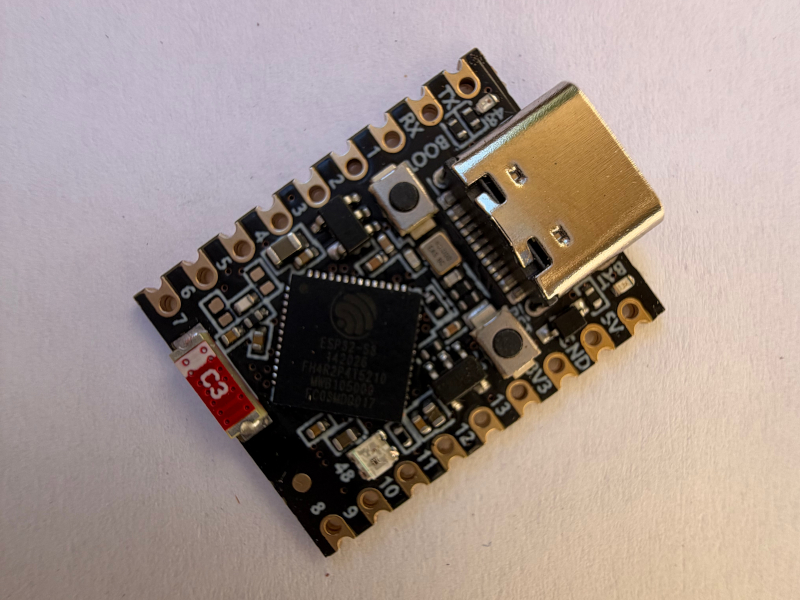
Generic ESP32S3 SuperMini by Generic
This is a tiny ESP32S3 board exposing a wealth of GPIO connections – 35 in total. It has 4MB Flash and 2MB PSRAM. It is available in a number of sites without a listed manufacturer which is why it is listed as a Generic ESP32S3 Supermini.
- ESP32-S3FH4R2 dual-core Xtensa® 32-bit LX7 processor - up to 240MHz
- USB Type-C Port
- WS2812 RGB LED
- BOOT button Press it and then press the RESET button to enter download mode
- RESET button
- 35 GPIO contacts (15 available on breadboard friendly castelated edges, 20 on the bottom of the board through exposed pads)
- 2.4G ceramic antenna
- Supports 2.4GHz Wi-Fi (802.11 b/g/n) and Bluetooth® 5 (LE)
- Built in 512KB of SRAM and 384KB ROM, onboard 4MB Flash memory and 2MB PSRAM
- Castellated module and onboard ceramic antenna, allows soldering direct to carrier boards
- Supports flexible clock, module power supply independent setting, and other controls to realize low power consumption in different scenarios
Learn more
For more information please see the ESPboards blog page
Purchase
Amazon search in case previous link doesn’t work (may pick up XIAO and others which is are different boards so read carefully):
Amazon search ESP32S3 Supermini
Contribute
Have some info to add for this board? Edit the source for this page here.
Absolute Newest
Every time we commit new code to CircuitPython we automatically build binaries for each board and language. The binaries are stored on Amazon S3, organized by board, and then by language. These releases are even newer than the development release listed above. Try them if you want the absolute latest and are feeling daring or want to see if a problem has been fixed.
Previous Versions of CircuitPython
All previous releases of CircuitPython are available for download from Amazon S3 through the button below. For very old releases, look in the OLD/ folder for each board. Release notes for each release are available at GitHub button below.
Older releases are useful for testing if you something appears to be broken in a newer release but used to work, or if you have older code that depends on features only available in an older release. Otherwise we recommend using the latest stable release.