
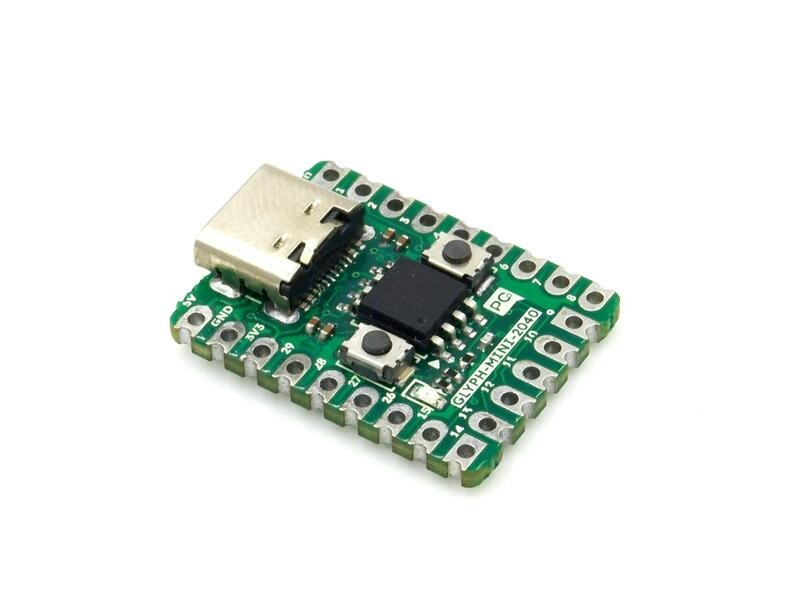
Glyph Mini 2040 by Pcbcupid
The Pcbcupid Glyph Mini 2040 is a compact, high-performance microcontroller board designed for space-constrained embedded and educational projects. Powered by the Raspberry Pi Rp2040 dual-core Arm Cortex-M0+ processor running at up to 133 MHz, it offers 264KB of SRAM and 8MB of external QSPI flash for program storage.
It features 20 GPIO pins, 12-bit ADC inputs, I²C, SPI, USB Serial, and UART peripherals for seamless interfacing with sensors, displays, and external modules. Castellated pads allow direct soldering onto carrier boards, and the USB-C connector keeps it modern and easy to use.
Inside the Glyph Mini 2040 is a ‘permanent ROM’ USB UF2 bootloader. When you want to program new firmware, hold down the BOOT button while plugging it into USB (or pulling down the RUN/Reset pin to ground) and it will appear as a USB disk drive you can drag the firmware onto. Just note you don’t double-click reset instead hold down BOOT during startup to enter the bootloader.
For peripherals, there are two I2C controllers, two SPI controllers, and two UARTs multiplexed across the GPIO check the pinout for which pins map to which. There are 16 PWM channels, each pin has a channel it can be set to.
There’s no I2S peripheral, SDIO, or camera but instead of specific hardware support for these, the Glyph Mini 2040 comes with the PIO state machine system. This is a unique and powerful way to create custom hardware logic and data processing blocks that run independently without consuming CPU.
While the Glyph Mini 2040 has 264KB of onboard RAM, flash memory is provided by an external QSPI chip. The Glyph Mini 2040 has 8MB of flash, shared between the running program and file storage for MicroPython or CircuitPython. With C/C++ you get the full 8MB with Python you’ll have about 7MB remaining for code, files, images, fonts, etc.
Board specifications
- Rp2040 microcontroller chip designed by Raspberry Pi
- Dual-core Arm Cortex M0+ processor, flexible clock running up to 133 MHz
- 264KB of SRAM, and 8MB of on-board Flash memory
- USB-C connector for programming and power
- Castellated pads for direct carrier board soldering
- Onboard LED on GP16
- USB 1.1 with device and host support
- Low-power sleep and dormant modes
- Drag-and-drop programming using mass storage over USB
- 2 × SPI, 2 × I2C, 2 × UART peripherals
- 4 × 12-bit ADC inputs (GP26–GP29)
- 16 × controllable PWM channels
- 8 × Programmable I/O (PIO) state machines for custom peripheral support
- Accurate clock and timer on-chip
- Temperature sensor
- Accelerated floating-point libraries on-chip
- Dimensions: 18mm × 23.5mm × 1.8mm
Learn More
Purchase
Contribute
Have some info to add for this board? Edit the source for this page here.
CircuitPython 10.3.1
This is the latest stable release of CircuitPython that will work with the Glyph Mini 2040. Use this release if you are new to CircuitPython.
Modules included in this download
_asyncio _bleio _bleio (HCI co-processor) _pixelmap adafruit_bus_device adafruit_pixelbuf aesio alarm analogbufio analogio array atexit audiobusio audiocore audiodelays audiofilewriter audiofilters audiofreeverb audioi2sin audiomixer audiomp3 audiopwmio audiospeed binascii bitbangio bitmapfilter bitmaptools bitops board builtins builtins.pow3 busdisplay busio busio.SPI busio.UART codeop collections countio digitalio displayio epaperdisplay errno floppyio fontio fourwire framebufferio getpass gifio hashlib i2cdisplaybus i2ctarget imagecapture io jpegio json keypad keypad.KeyMatrix keypad.Keys keypad.ShiftRegisterKeys keypad_demux keypad_demux.DemuxKeyMatrix locale lvfontio math memorymap microcontroller msgpack neopixel_write nvm onewireio os os.getenv paralleldisplaybus pulseio pwmio qrio rainbowio random re rgbmatrix rotaryio rp2pio rtc sdcardio select sharpdisplay storage struct supervisor supervisor.get_setting synthio sys terminalio tilepalettemapper time touchio traceback ulab usb usb_audio usb_cdc usb_hid usb_host usb_midi usb_video vectorio warnings watchdog zlibFeatures: USB-C, Breadboard-Friendly
CircuitPython 11.0.0-alpha.2
This is the latest development release of CircuitPython that will work with the Glyph Mini 2040.
Alpha development releases are early releases. They are unfinished, are likely to have bugs, and the features they provide may change. Beta releases may have some bugs and unfinished features, but should be suitable for many uses. A Release Candidate (rc) release is considered done and will become the next stable release, assuming no further issues are found.
Please try alpha, beta, and rc releases if you are able. Your testing is invaluable: it helps us uncover and find issues quickly.
Release Notes for 11.0.0-alpha.2
Modules included in this download
_asyncio _bleio _bleio (HCI co-processor) _pixelmap adafruit_bus_device adafruit_pixelbuf aesio alarm analogbufio analogio array atexit audiobusio audiocore audiodelays audiofilewriter audiofilters audiofreeverb audioi2sin audiomixer audiomp3 audiopwmio audiospeed binascii bitbangio bitmapfilter bitmaptools bitops board builtins builtins.pow3 busdisplay busio busio.SPI busio.UART codeop collections countio digitalio displayio epaperdisplay errno floppyio fontio fourwire framebufferio getpass gifio hashlib i2cdisplaybus i2ctarget imagecapture io jpegio json keypad keypad.KeyMatrix keypad.Keys keypad.ShiftRegisterKeys keypad_demux keypad_demux.DemuxKeyMatrix locale lvfontio math memorymap microcontroller msgpack neopixel_write nvm onewireio os os.getenv paralleldisplaybus pulseio pwmio qrio rainbowio random re rgbmatrix rotaryio rp2pio rtc sdcardio select sharpdisplay storage struct supervisor supervisor.get_setting synthio sys terminalio tilepalettemapper time touchio traceback ulab usb usb_audio usb_cdc usb_hid usb_host usb_midi usb_video vectorio warnings watchdog zlibFeatures: USB-C, Breadboard-Friendly
Absolute Newest
Every time we commit new code to CircuitPython we automatically build binaries for each board and language. The binaries are stored on Amazon S3, organized by board, and then by language. These releases are even newer than the development release listed above. Try them if you want the absolute latest and are feeling daring or want to see if a problem has been fixed.
Previous Versions of CircuitPython
All previous releases of CircuitPython are available for download from Amazon S3 through the button below. For very old releases, look in the OLD/ folder for each board. Release notes for each release are available at GitHub button below.
Older releases are useful for testing if you something appears to be broken in a newer release but used to work, or if you have older code that depends on features only available in an older release. Otherwise we recommend using the latest stable release.