
Pimoroni Explorer (RP2350) by Pimoroni
An electronic adventure playground for physical computing, built around the high-performance RP2350B chip.
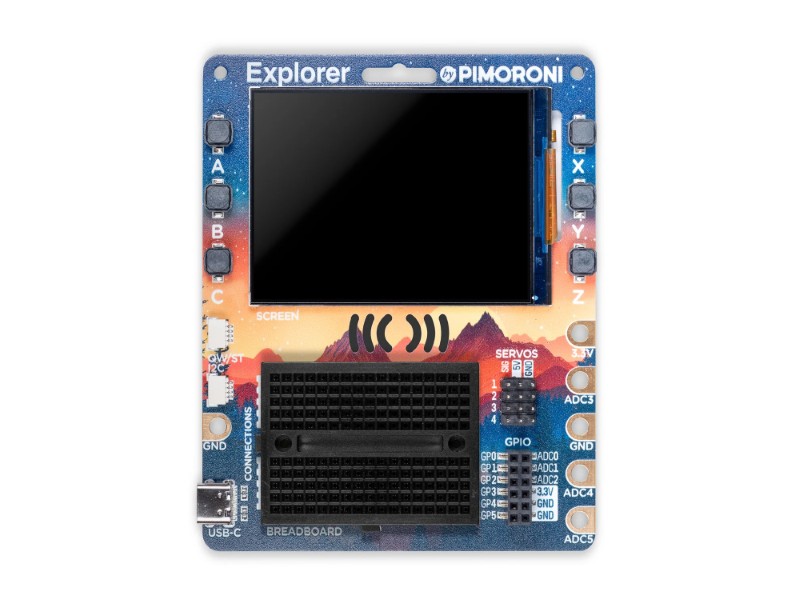
Pimoroni Explorer is designed for playing with circuits, building science experiments, and prototyping tiny robots. It features a large 2.8” IPS LCD screen surrounded by six tactile buttons, making it easy to monitor and control your projects. With an integrated speaker, mini breadboard, servo headers, and analog-friendly crocodile clip terminals, it’s a self-contained workstation for tinkering without the mess of loose wires.
Features
- Powered by RP2350B (Dual Arm Cortex M33 running at up to 150MHz with 520KB of SRAM)
- 16MB of QSPI flash supporting XiP
- 2.8” IPS LCD screen (320 x 240 pixels, ST7789V driver)
- USB-C connector for power and programming
- Mini breadboard for circuit prototyping
- Piezo speaker for audio feedback
- 6x user-controllable tactile switches, plus reset and boot buttons
- 2x Qw/ST (Qwiic/STEMMA QT) connectors for I2C breakouts
- 4x 3-pin servo outputs
- 6x crocodile clip terminals (3x ADCs, plus 3.3V and Ground)
- 2-pin JST-PH connector for adding a battery (input voltage 3V to 5.5V)
- Fully-assembled (no soldering required)
- Programmable with C/C++ or MicroPython
Getting Started
See this Adafruit Playground note to help you begin your journey!
About RP2350
The RP2350 chip is the “Double Quarter Pounder & Fries” to the RP2040’s “Double Cheeseburger.” It features upgraded dual-core Arm Cortex-M33 processors and introduces optional RISC-V cores for specialized development.
In addition to the modern M33 ARM cores, you get a significant boost in PIO capability, lower power states for battery-efficient projects, and a robust security architecture.
Performance-wise, you can expect “real world” MicroPython tests to run up to 2x faster than on the RP2040, while floating-point math in C/C++ is up to 20x faster. The extra on-chip RAM and external PSRAM support make a massive difference when working with memory-intensive operations like driving the Explorer’s high-resolution display.
The Pimoroni Explorer uses the RP2350B variant, which features 48 usable GPIO pins, enabling the dense integration of the screen, servos, and expansion headers all on one board.
Purchase
Contribute
Have some info to add for this board? Edit the source for this page here.
Absolute Newest
Every time we commit new code to CircuitPython we automatically build binaries for each board and language. The binaries are stored on Amazon S3, organized by board, and then by language. These releases are even newer than the development release listed above. Try them if you want the absolute latest and are feeling daring or want to see if a problem has been fixed.
Previous Versions of CircuitPython
All previous releases of CircuitPython are available for download from Amazon S3 through the button below. For very old releases, look in the OLD/ folder for each board. Release notes for each release are available at GitHub button below.
Older releases are useful for testing if you something appears to be broken in a newer release but used to work, or if you have older code that depends on features only available in an older release. Otherwise we recommend using the latest stable release.