
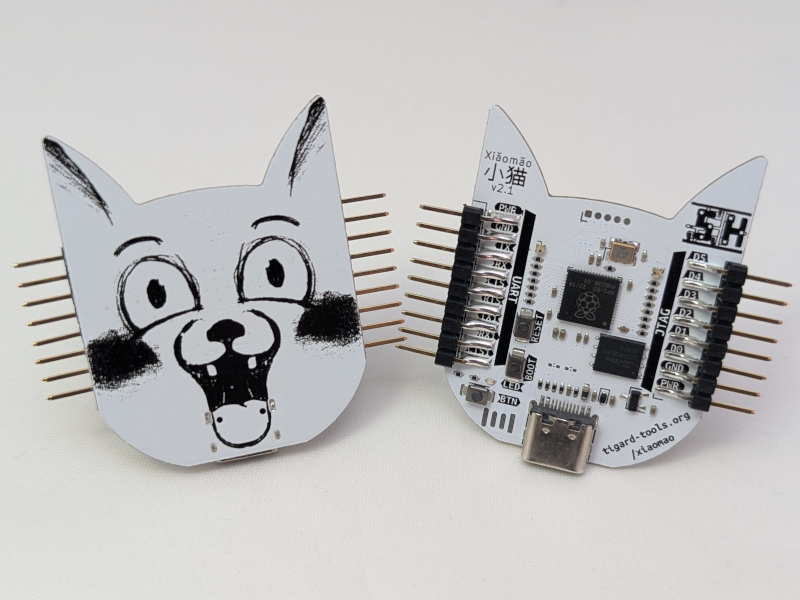
Xiaomao by SecuringHardware.com
Xiǎomāo is a development board geared toward hardware hacking and hardware implant design that can safely interfacing with a wide range of logic levels
Xiǎomāo (小猫) means ‘small cat’ and gets its name from the original revision which used the small Seeed Studio XIAO module with the catlike tigard-tools wiring harnesses. The current version, Xiǎomāo v2 is a redesign based on an RP2040 but the Xiǎomāo name (and shape) stuck.
All the GPIO pins have 200 ohm current limiting resistors that should protect both the target and the device. If you have a Tigard, you can re-use the wiring harnesses. You should be able to tap power and ground from your target system to get your device running in standalone implant mode.
Alongside a logic analyzer and an I/O interface board, a simple microcontroller board rounds out a basic hardware hacking toolkit, allowing you to bitbang proprietary protocols, search for disabled interfaces, log data, drop payloads, and act as an implant-in-the-middle. For example, Hecate is a CircuitPython framework for UART logging, payloads, and interdiction. It will work on any board but was built with Xiǎomāo in mind.
Purchase
- Not planned for sale, but as a freebie with some workshops
Learn More
- Documentation includes all the board files, as well as some recommended use cases and code samples.
Contribute
Have some info to add for this board? Edit the source for this page here.
Absolute Newest
Every time we commit new code to CircuitPython we automatically build binaries for each board and language. The binaries are stored on Amazon S3, organized by board, and then by language. These releases are even newer than the development release listed above. Try them if you want the absolute latest and are feeling daring or want to see if a problem has been fixed.
Previous Versions of CircuitPython
All previous releases of CircuitPython are available for download from Amazon S3 through the button below. For very old releases, look in the OLD/ folder for each board. Release notes for each release are available at GitHub button below.
Older releases are useful for testing if you something appears to be broken in a newer release but used to work, or if you have older code that depends on features only available in an older release. Otherwise we recommend using the latest stable release.